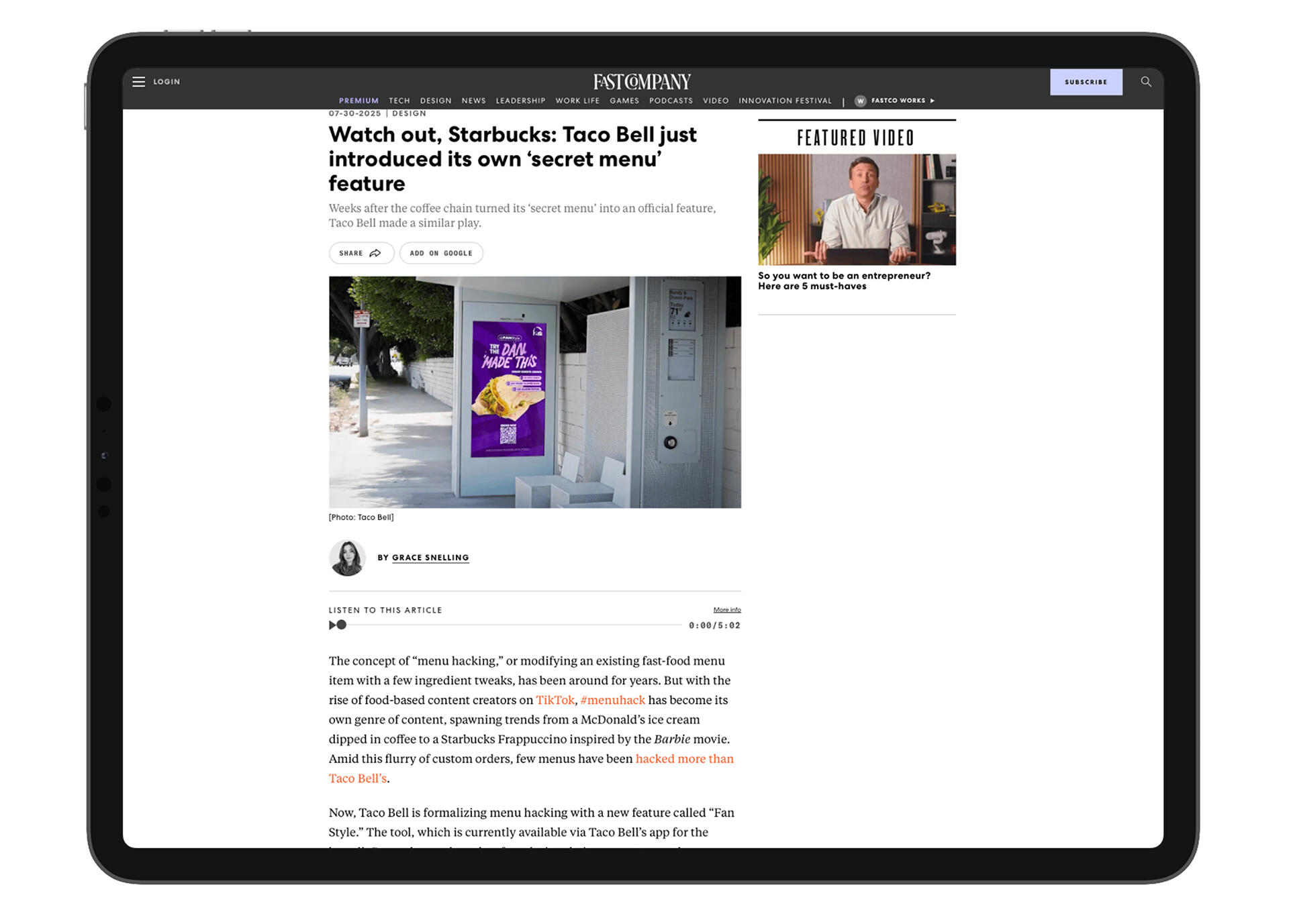
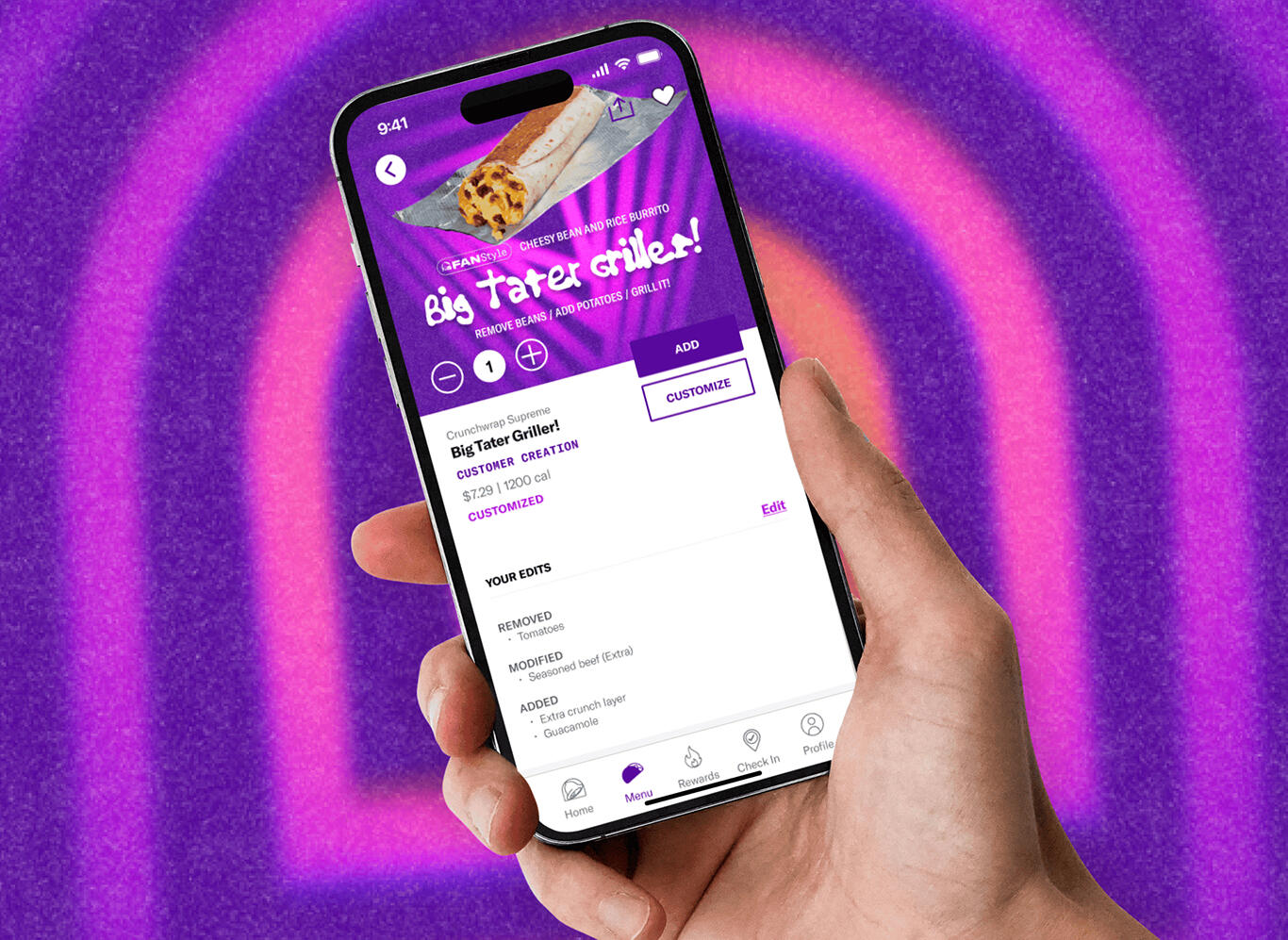
Empowering Fans to Customize, Share, and Earn with Fan Style
A bold personalization feature launched in Taco Bell’s mobile app, Fan Style let users create, name, and share custom menu items earning loyalty points when others purchased them. Designed to deepen engagement through creativity, social sharing, and gamified rewards, it turned everyday orders into shareable fan moments.
My role
Lead product designer • Interaction design • Visual designer • Creative directionPlatforms
Native iOS and Android appsYear
2025
Research insights and user feedback
User research surfaced the following core themes shaping Fan Style’s design:
Frictionless personalization: Users wanted to customize quickly and intuitively. Streamlining the product detail page and reducing taps became essential.
Control over visibility: Fans valued clarity between private and public experiences prompting a clear distinction between personal favorites and shared Fan Styles.
Motivation through recognition: Participants responded strongly to social validation. Although a planned leaderboard was later constrained legally, the reward element remained central to the feature.
Opportunity
How might we empower fans to personalize and share their Taco Bell creations to boost engagement and business impact?
Goals
Seamless customization and sharing: Enable easy creation, naming, and sharing of custom items.
Branded share assets: Deliver Taco Bell‑approved visuals optimized for TikTok, Instagram, and other channels.
Reward engagement: Connect loyalty tracking to purchases and shared creations.
Iterations
Multiple design cycles refined naming, visuals, and flows. Early “hack”‑themed prototypes evolved into a friendlier, highly branded experience.As legal and technical constraints emerged, we replaced the contest leaderboard with a curated “Top Fan Styles” page to sustain recognition while protecting the brand.Usability testing guided refinements to asset options, sharing flows, and moderation workflows. Each iteration moved the product closer to a polished experience fans could proudly share.
Challenges
Balancing creativity with brand safety required a robust moderation system for names, preset style assets, and protected design components.
Product gaps were addressed with visual cues highlighting modified items. Although the leaderboard was fully built, legal constraints shifted the experience toward a safer curated model.
Final designs
Fan Style centered on native app‑optimized “style cards” featuring ingredient tags, deep links for quick personalization, and a “My Styles” library to manage creations. Branded portrait view assets were tailored for major social platforms to ensure a seamless, on‑brand experience.
Outcome
Fan Style transformed customization into a social movement blending creation, recognition, and measurable impact.
Strong early engagement: In its July 2025 launch, over 35,000 Fan Styles were created, generating 3,600+ checkouts. The Cheesy Bean & Rice Burrito was the top customizable base with fans averaging four customizations per order.
Sales lift: Orders featuring a Fan Style averaged 4% higher order value than standard purchases.
Cultural buzz: The feature drove organic excitement and earned coverage from outlets like Fast Company and People Magazine.

Safeguarding families with Meta Family Center
The Meta Family Center project is about creating a new online platform to support families in managing their online experiences focusing on valuable resources, digital well-being, and a positive user experience.Integrating multilingual support also aligns with the project's goal of inclusivity. The initial project involved a collaborative effort between teams at Codazen and Meta.
My role
Lead designer • Interaction designer • Visual designer • Design systemPlatforms
Desktop web • Tablet web • Mobile webYear
2023
Research insights
The research identified several user needs to address for how the product should be designed.

Unequal distribution of digital literacy skills: Despite using Meta products, families would have unequal levels of digital literacy.
Lack of guidance on digital wellness and safety: Families wanted to find comprehensive guidance on digital wellness, online safety, and privacy.
Language and cultural barriers: A lack of tools and resources available in multiple languages and tailored to diverse cultural backgrounds is limiting.
Opportunity
How might we globally empower families to manage online experiences effectively using digital tools?
Iterations
The designs went through a number of iterations before we had a shippable minimum viable product (MVP) candidate.
Challenges
The Meta Family Center project faced challenges in managing an accelerated design and migration process, utilizing a proprietary Meta design system, and transitioning from Instagram servers to Meta's servers within a tight timeline. Timely vendor content integration during the platform transition also posed difficulties.
Final Designs
The following designs shipped publicly to users around the world.
Outcome
The platform launched to 100% of US users in March 2022 with the following key outcomes.
Launching strong: Reached approximately 500k visitors within the first week of launch, 1M visitors within the first month of launch, and 10M visitors by mid-2022.
Driving growth: The pages have helped to raise awareness about the importance of managing online presence and keeping personal information secure and have contributed to an increase in sign-ups for Family Center and Education Hub accounts.
Customer kudos: The pages have received positive feedback from users through user research studies and social media.
Users have found the pages to be informative, easy to use, and visually appealing, and have appreciated the step-by-step instructions, videos, and testimonials from other users that are available on the pages.
Update
The product was launched to 100% of global users by early 2023 and ongoing design iterations were in progress.

Revamping Portal: a UX redesign journey
The Facebook Portal site redesign aimed to enhance the user experience, showcase new Portal Go and Portal+ devices, and address outdated design and content. The project involved collaboration between Codazen and Meta teams.
My role
Senior designer • Visual designer • Design systemPlatforms
Desktop web • Tablet web • Mobile webYear
2021
Research insights
Research identified several user needs to address for how the product should be created.

Enhanced user experience: Addressing user experience challenges related to outdated design and content to provide a more intuitive and engaging experience for the users.
Effective showcasing of new devices: The redesign aimed to effectively showcase and promote the new Portal devices, Portal Go, and Portal+, indicating a need for clear and compelling presentation of product information and features.
Seamless navigation and media optimization: Optimizing media elements for a seamless user experience indicating a need for easy navigation and well-optimized media content to enhance the overall user experience.
Opportunity
How can we use the Portal redesign to promote new devices, enhance the user experience, and optimize navigation and media for a compelling user-friendly experience?
Goals
The following items were key problems turned into opportunities to solve for during the creation of the platform.
Outdated design and content: This was an opportunity to modernize the site to effectively showcase and promote the new Portal devices addressing the challenge of outdated design and content.
User experience challenges: The opportunity involved enhancing the user experience by optimizing navigation and media elements turning the challenge of user experience limitations into an opportunity for a more compelling and user-friendly online experience.
Lack of effective device promotion: The opportunity was to strategically promote the new Portal devices turning the challenge of insufficient device promotion into an opportunity to drive awareness and engagement with the new products.
Iterations
The redesign went through a number of iterations before we had a shippable design candidate.
Challenges
The Facebook Portal site redesign faced pressure to create a compelling user experience, drive more traffic, and increase sales of new Portal devices amid strong competition.
Final designs
These designs were publicly released worldwide.
Outcome
The redesign launched to 100% of users in September 2021 and the following items were key outcomes.
Improved user experience: The redesign aimed to enhance the user experience by modernizing the site, optimizing navigation, and media elements ultimately creating a more compelling and user-friendly online experience for visitors.
Effective showcasing of new devices: The project focused on effectively showcasing and promoting the new Portal devices, Portal Go and Portal+, indicating a successful outcome in driving awareness and engagement with the new products.
Improved user experience and traffic: The redesign aimed to drive more traffic to the site ultimately leading to an increase in device sales. This outcome was particularly significant considering the competition from other device makers.
Update
In November 2022, Meta shifted its focus leading to the discontinuation of Portal devices as part of portfolio rationalization to streamline operations and reduce costs.This decision followed a June 2022 announcement to transition Portal from a consumer product to a business tool resulting in substantial impacts and iterative adjustments in later designs that I was a part of as the project was phased out.
Hi, I’m Elliot.
I’m an experienced Product Designer from Southern California with a proven track record of creating engaging user experiences and effective collaboration at industry-leading companies.My design approach is influenced by various aspects of my life. I run marathons and have a broad perspective from traveling and living abroad. All these things come together in how I tackle problems and create solutions.

I solve complex problems for industry-leading companies.

I design engaging user experiences specializing in web and mobile design with a focus on modern principles.
Skills
Interaction design • Visual design • Design systems • Product strategy • Prototyping • Usability research • CollaborationTools
Figma • Adobe Creative Cloud • AI tools • Sketch • Framer • Axure • InvisionTechnology
HTML • CSS
I collaborate with industry-leading product teams to integrate my designs into their features and services.

A few kind words
Warren TsangExperian Consumer Services,
Lead Product Designer"If you're looking for a really experienced, professional and dependable designer... He’s a great, senior-level Product Designer who checks all the key boxes. He learns new things easily, takes initiative, provides thought leadership and is a consummate professional. Plus he's an enjoyable, positive person to interact with that can really raise a team's culture with his example.”
Jennifer MansdorfKelley Blue Book,
User Experience Design Manager"Elliot is one of those rare well-rounded folks... His strong work ethic, dependability, and attention to detail make him an asset to any team.”
Annette Rodriguez ChangCox Automotive,
Principal Product Manager"Elliot has a great eye for design and paying close attention to detail. Dedicated and passionate about his work and listening to users. Always collaborates with stakeholders, circles back to research insights, asks questions, and seeks clarification."
My design approach is grounded in a strategic process
I draw inspiration from diverse experiences including my passion for running and living and traveling abroad.The level of effort depends on each project’s scope and complexity. My approach integrates strategic planning, research-driven insights, and a strong focus on user needs to deliver solutions tailored to each project’s unique requirements.

Research and discovery
Before diving into design, I explore initial ideas laying the foundation by carefully managing time and resources to understand users and market trends. My goal is to uncover deep user needs enriched by insights from my global experiences.

Conceptualization
Every project kickoff resembles the start of a marathon. I bring a burst of creativity, setting clear goals, and envisioning the final outcome. Close collaboration with product and engineering ensures our vision is feasible and sets a robust foundation for the journey ahead.

Iterative design
Design is not a sprint but a series of training cycles focused on continuous improvement. I actively seek feedback and conduct user testing refining designs with each iteration much like adjusting pace and strategy to prepare for a race.

Finalization and delivery
In the final phase, I work closely with engineering and product teams to seamlessly transition concepts into reality. My global perspective helps me consider cultural nuances ensuring our solutions resonate with diverse audiences. This collaborative adaptability parallels the flexibility required when navigating different cultures.